"On Uncertainty"
December 21, 2025
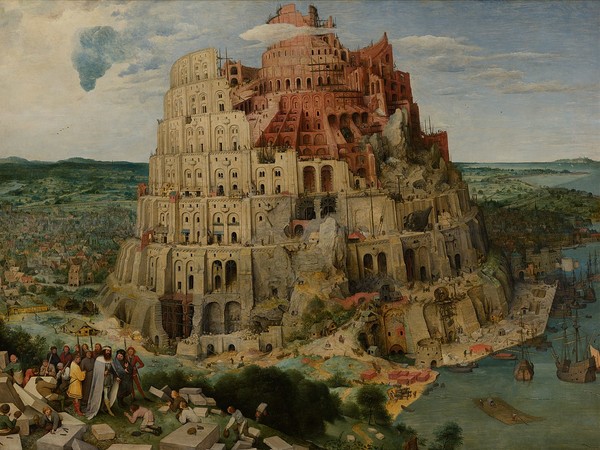
Pieter Bruegel de Oude - "The Tower of Babel" (1563)
I.
Listening to an intervention by Professor Alessandro Barbero, the esteemed medieval historian, I found in his narrative a thread that illuminated the central theme of this essay: the conflictual relationship between certainty and uncertainty in our interpretation of history. Barbero recounted the story of Salimbene, a Franciscan friar from Parma whose vicissitudes embody a lesson that remains extraordinarily relevant to our understanding of the fragility of interpretive systems. It is from that account that this text takes its origin.
In December 1250, as Frederick II of Swabia lay dying in a Puglian castle, consumed by dysentery, a Franciscan friar named Salimbene de Adam found himself confronted with the collapse of an entire epistemological universe. For years, Salimbene had believed with almost mathematical fervor in the Joachimite prophecies: the Bible, properly deciphered, contained the complete code of human history. Every event of the Old Testament constituted a variable that, inserted into the interpretive equation, predicted with precision the future of the Church. Frederick II was the announced Antichrist, the “hammer of the earth,” and according to the calculations of the followers of Joachim of Fiore, he was destined to persecute the Church until 1260, the fateful year of the advent of the Third Age, the Age of the Holy Spirit.
The Emperor’s death, banal, premature, ten years short of the predicted deadline, shattered this certainty. Salimbene, with a honesty that still astonishes us today, admitted in his Chronicle that he had been “deceived” (deceptus). The more obstinate confraternity brothers maintained that Frederick was alive and hidden, embodying the myth of the sleeping king. But the pragmatic friar from Parma accepted reality: history had taken a path different from that written in the sacred codices. The model had failed.
Between the entrails of a goat examined by an Etruscan augur and the graph with moving averages of a modern financial analyst stretches a distance of three thousand years, yet the mental structure remains identical: to extract from the past a pattern that permits predicting the future. Salimbene sought in the Bible the function f(t) that would map historical time; the Joachimites believed they had found concordance, the one-to-one correspondence between Old Testament events and the destiny of the Church. When Frederick died in 1250 rather than surviving until 1260, the prediction error was so macroscopic as to invalidate the entire system.
The question that emerges, mutatis mutandis, concerns the actual existence of an informative structure in the past capable of illuminating the future, or whether every attempt, even the mathematically sophisticated, is destined to be refuted by the dysentery of the day.
II.
Before proceeding, it is necessary to establish common ground. Let us call a system any collection of interconnected elements that evolves over time. Let us call a model a simplified representation of such a system, constructed to understand it and, if possible, to predict its future states. Let us call inference the logical process by which, from the observation of past states of the system, we attempt to deduce information about states not yet observed.
A system is defined as deterministic if, given its state at time t₀ and the laws governing it, its state at any time t > t₀ is uniquely determined. It is defined as stochastic if it admits an intrinsic component of unpredictability, a variability that cannot be reduced to mere ignorance of initial conditions.
To develop the reasoning, it is necessary to accept three fundamental premises:
Axiom I: The past exists and leaves observable traces. History is not illusion: the previous states of a system have actually occurred and have produced measurable consequences. Frederick II truly died in 1250; the fact is as certain as any historical fact can be.
Axiom II: High-entropy systems maintain memory of their past. With the exception of pure Markovian systems, where the future depends solely on the present state, and quantum phenomena, most of the complex systems in which we live (economies, societies, ecosystems) bear in their current state the imprint of what they have been. Path-dependency is real.
Axiom III: Variability contains information. The stochastic component of a system does not constitute noise to be eliminated, but rather a signal to be interpreted. It is precisely in the epsilon, in the deviation from the deterministic model, that the most precious information about future uncertainty resides.
III.
From these axioms flows a series of logical consequences.
If we accept Axiom I and Axiom II, it follows that looking at the past is not a meaningless operation. The current state of a system is, at least partially, a function of its history. This justifies modeling: we can construct representations of the present founded on the observation of the past. Salimbene’s error did not consist in looking at history, but in believing that history followed a rigid script, a deterministic and immutable pattern. The fallacy resides in rigid interpretation, not in the act of observation itself.
However, and here Axiom III becomes crucial, the systems in which we live are not deterministic. Accepting this truth does not represent intellectual surrender, but epistemological rigor. The stochastic component does not constitute a “misalignment” to be corrected, but the very signature of reality. When a statistical model includes an error term ε, it is not admitting a failure: it is recognizing that uncertainty is constitutive of the system.
The moderation of uncertainty, not its elimination, represents the central problem of inference. A model that claims to reduce ε to zero is lying, exactly as the Joachimite prophecies lied when they promised a perfect concordance between Scripture and history. The power of modern statistics resides precisely in its opposite: in quantifying uncertainty, in measuring variance, in extracting from variability itself the information necessary to formulate probabilistic predictions.
A fortiori, it follows that the problem of prediction is not a matter of content but of method. What matters is not so much what we observe in the past, but how we interpret it. Salimbene observed real biblical events (the destruction of Babylon, the exile, persecutions); his error consisted in applying a deterministic model to a stochastic system. The modern analyst observes real data (prices, returns, correlations); his potential error is identical: believing that the lines drawn on a graph are natural laws rather than probabilistic patterns subject to regime shifts.
The holistic vision here proposed accepts the paradox: yes, the past informs the future; no, it does not determine it. The best model is not one that eliminates uncertainty, but one that includes it explicitly, that assigns confidence intervals, that admits its own fallibility. Ceteris paribus, a system may follow a trend; but ceteris is rarely paribus.
When dysentery ended the life of Frederick II ten years before the predicted time, Salimbene did not abandon either faith or reason. He abandoned the certainty of the deterministic code. He accepted, with sorrow but with honesty, that history contained an irreducible epsilon.
IV.
Eight hundred years later, the lesson remains intact. Predicting the future is possible, but only in probabilistic terms. Looking at the past is necessary, but only if we accept that variability does not constitute a flaw in the model: it is the model itself. The most precious information does not reside in the mean, but in the dispersion around the mean. The most reliable oracle is not one that promises certainty, but one that quantifies uncertainty.
Whoever accepts these initial axioms (the traceability of the past, the memory of complex systems, the information contained in variability) cannot but share the final conclusion: the prediction of the future is a legitimate art, but whoever promises determinism lies as much as the Joachimite prophets. Wisdom does not lie in rejecting models, but in embracing them with epistemological humility, recognizing that between the code and the dysentery, history always chooses to surprise us.
To the reader I leave the calculation of the consequences.