"Causality at the Boundary: Quantum Indeterminacy and the Thomistic Proof"
January 30, 2026
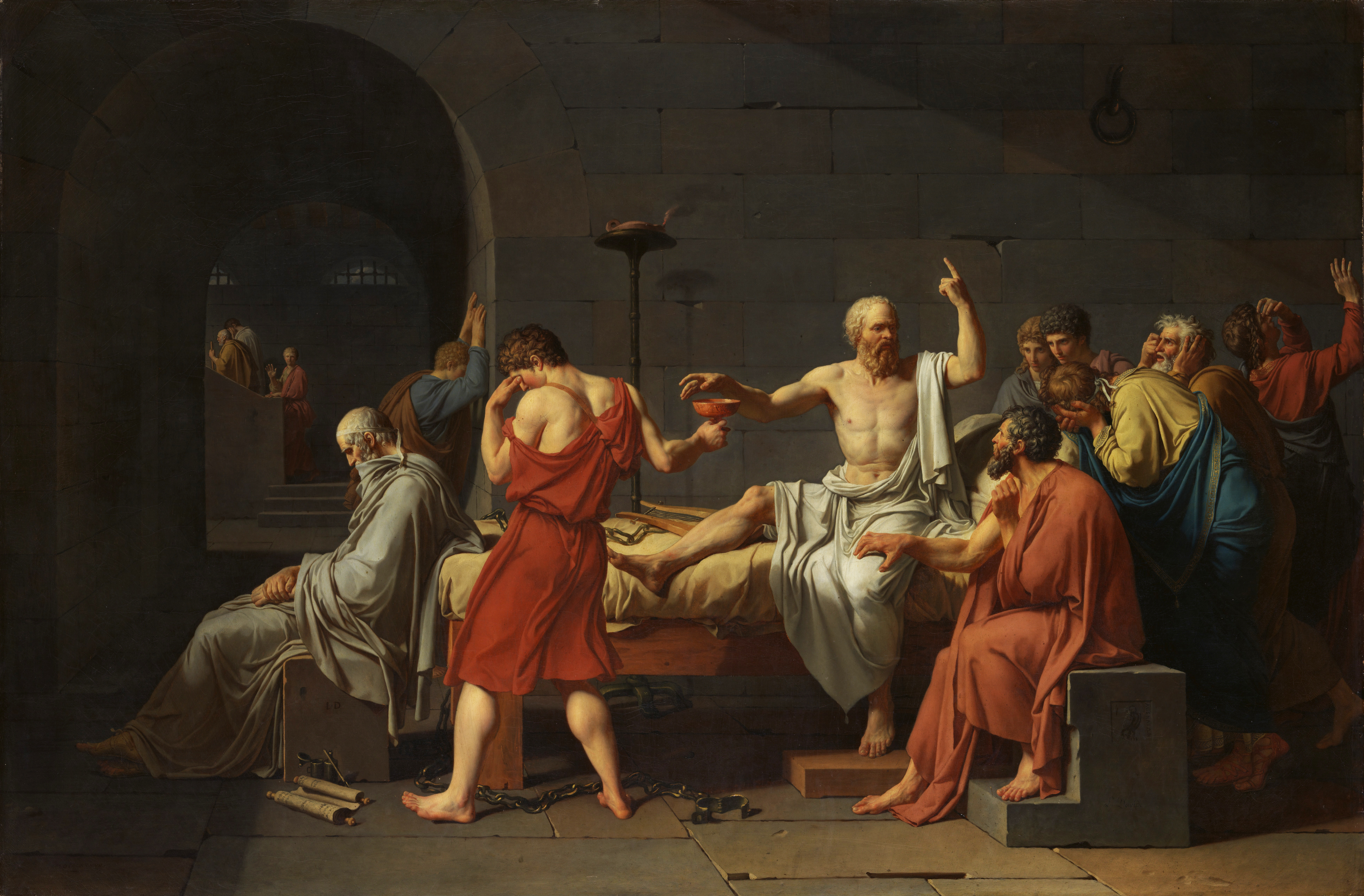
Jacques-Louis David - "The Death of Socrates" (1787)
I.
In the thirteenth century, within the walls of the University of Paris, Thomas Aquinas constructed what he believed to be a demonstrative proof of God’s existence. The Secunda Via (the argument from efficient causality) proceeds with the rigor of Euclidean geometry: every effect has a cause; an infinite regress of causes is impossible; therefore, there must exist a First Cause, itself uncaused. The syllogism appears impeccable, the conclusion inevitable.
Eight centuries later, we observe quantum fluctuations materializing particles from apparent nothingness, we measure the cosmic microwave background radiation of a universe that emerged 13.8 billion years ago from a singularity of infinite density, and we confront the possibility that causality itself (the bedrock upon which Aquinas built his cathedral) may be a macroscopic illusion, a statistical artifact of decoherence.
The question that emerges is not whether Aquinas was right or wrong, but whether the entire framework of his reasoning survives contact with quantum indeterminacy and cosmological singularities. Does the Secunda Via constitute a timeless logical truth, or does it collapse under the weight of phenomena that admit no efficient cause?
II.
To proceed with precision, we must establish our formal framework.
Definition 1 (Efficient Cause): An entity A is an efficient cause of entity B if and only if the existence of B depends logically or physically upon a prior action or existence of A, and this dependency is irreflexive and antisymmetric.
Definition 2 (Causal Chain): A sequence ⟨C₀, C₁, C₂, …, Cₙ⟩ where each Cᵢ₊₁ is efficiently caused by Cᵢ.
Definition 3 (First Cause): An entity P such that P causes other entities but is itself uncaused; that is, there exists no X such that X efficiently causes P.
We now establish three axioms that formalize Aquinas’s reasoning:
Axiom A (Principle of Sufficient Causality): For every contingent entity E that exists, there exists an efficient cause C such that C causes E.
Axiom B (Impossibility of Infinite Regress): There cannot exist an infinite sequence ⟨…, C₋₂, C₋₁, C₀⟩ of efficient causes extending backward without terminus.
Axiom C (Observability of Causation): Causal relationships are observable features of reality, not merely epistemological constructs.
From these axioms, Aquinas’s conclusion follows with mathematical necessity:
Theorem 1 (Existence of First Cause): There exists at least one First Cause P.
Proof: Consider any contingent entity E₀. By Axiom A, there exists E₁ that causes E₀. Apply Axiom A recursively: for each Eₙ, there exists Eₙ₊₁ that causes it. This generates either (1) an infinite backward sequence, or (2) a terminal element P that is uncaused. By Axiom B, option (1) is excluded. Therefore, P exists.
The proof is formally valid. The question becomes: are the axioms true?
III.
Consider a uranium-238 nucleus. It will undergo alpha decay with a half-life of approximately 4.47 billion years. At any given instant t, the nucleus may decay, or it may not. Quantum mechanics provides a probability amplitude for the decay event but offers no mechanism, no hidden variable, no efficient cause that determines when the decay occurs.
Lemma 1 (Acausality of Quantum Events): There exist physical events for which no efficient cause, in the Thomistic sense, can be identified even in principle.
The Copenhagen interpretation, despite its philosophical difficulties, remains empirically unrefuted: the wave function evolves deterministically according to the Schrödinger equation, but its collapse upon measurement is fundamentally probabilistic. The event “the detector registers decay at time t” has no efficient cause within the standard framework.
This strikes directly at Axiom A. If quantum events (radioactive decay, spontaneous photon emission, vacuum fluctuations) occur without efficient causes, then the principle of sufficient causality fails at the foundational level of physical reality.
Objection 1: Perhaps the wave function itself constitutes the cause.
Response: The wave function describes a superposition of possibilities; it does not select among them. The collapse (or in Everettian terms, the branching) introduces genuine randomness that cannot be reduced to prior deterministic states. A cause that produces indeterminate effects is not an efficient cause in the Thomistic framework.
Objection 2: Hidden variable theories restore determinism.
Response: Bell’s theorem and subsequent experimental violations of Bell inequalities demonstrate that any hidden variable theory must be non-local, violating the causal structure of special relativity. The price of restoring Axiom A at the quantum level is the abandonment of locality: a Pyrrhic victory for the Thomistic framework.
We are forced to a provisional conclusion:
Proposition 1: If quantum mechanics accurately describes reality, then Axiom A is false for a non-trivial class of physical events.
IV.
The Big Bang presents a different challenge. Extrapolating general relativity backward in time, we encounter a singularity at t = 0: a point where density becomes infinite, spacetime curvature diverges, and the equations themselves collapse.
What caused the Big Bang?
Position 1 (The Singularity is Absolute): Time itself begins at t = 0. The question “what caused the Big Bang?” is malformed, analogous to asking “what is north of the North Pole?” There is no t < 0 in which a cause could exist.
Position 2 (Quantum Cosmology): Models such as the Hartle-Hawking no-boundary proposal or Vilenkin’s quantum tunneling suggest the universe emerged from a quantum vacuum state through a process governed by probabilistic laws, not efficient causation.
Position 3 (Cyclic or Eternal Models): The universe undergoes infinite cycles of expansion and contraction, or exists eternally in a multiverse framework where our Big Bang is merely a local event.
Each position undermines the Secunda Via differently:
-
Position 1 denies the applicability of causation at the boundary condition, rendering Axiom A vacuous at the cosmological origin.
-
Position 2 replaces efficient causality with quantum probability, echoing the failure of Axiom A at the microscopic level.
-
Position 3 resurrects precisely the infinite regress that Axiom B prohibits.
Consider Position 3 more carefully. Aquinas argued that an infinite regress is impossible because it would leave the chain of causation unexplained: it would push explanation indefinitely backward without resolution. But this argument contains a hidden assumption:
Hidden Assumption: Explanation requires a terminal element.
Modern mathematics has grown comfortable with infinite structures. The integers extend infinitely in both directions; this does not render them incoherent or unexplained. An eternal universe with infinite past might be metaphysically uncomfortable, but it is not logically contradictory.
Lemma 2 (Coherence of Infinite Causal Chains): An infinite regress of efficient causes is not logically impossible if each element in the sequence is sufficiently explained by its predecessor, and the sequence as a whole requires no external explanation.
This opens a fissure in Axiom B. The impossibility of infinite regress was asserted, not demonstrated. If we demand that reality conform to our explanatory preferences, we commit a subtle anthropocentrism: we mistake epistemic satisfaction for ontological necessity.
Proposition 2: Axiom B is not a logical necessity but an epistemological preference, potentially contradicted by cosmological models with infinite temporal extent.
V.
The most profound challenge emerges not from any specific physical theory but from the recognition that causality itself may be scale-dependent and emergent.
At the quantum level, events occur without efficient causes. At the macroscopic level, causality appears robust and universal. This suggests:
Proposition 3: Causality is not a fundamental feature of reality but an emergent property of decoherence and statistical averaging in high-entropy systems.
Decoherence (the interaction of quantum systems with their environment) suppresses superposition and produces effectively classical behavior. In this framework, the deterministic causality that Aquinas observed is real but derivative. It is a thermodynamic phenomenon, not a metaphysical bedrock.
This inversion is fatal to the Secunda Via. If causality emerges from more fundamental acausal processes, then the argument from efficient causation cannot reach down to the ground floor of reality. The First Cause would itself require explanation in terms of the quantum substrate from which causation crystallizes.
Theorem 2 (Incompleteness of the Causal Argument): If causality is emergent rather than fundamental, then arguments based on causal regress cannot establish the existence of an uncaused cause, because the framework of causation itself does not apply at the foundational level.
VI.
We arrive at a position of structured uncertainty.
The Secunda Via remains formally valid within its axiomatic framework, just as Euclidean geometry remains valid within its postulates. But the physical world appears to violate Aquinas’s axioms at both the quantum and cosmological scales.
Conclusion 1: The argument from efficient causality does not constitute a proof of God’s existence if the axioms upon which it depends are empirically false.
Yet we must avoid the equal and opposite error: claiming that modern physics has disproven the existence of a First Cause. Science operates within methodological naturalism; it investigates natural causes but cannot pronounce on whether a supernatural cause exists beyond the causal chains it studies.
Conclusion 2: Physics neither confirms nor refutes the Secunda Via; it renders its axioms empirically questionable and philosophically optional.
The uncertainty is irreducible. Between the certainty of medieval scholasticism and the quantum foam of modern cosmology, we inhabit a space of probabilistic inference and epistemic humility.
Aquinas sought a demonstrative proof, a necessity that would compel assent. What we possess instead is a landscape of theories (some more probable than others, none certain). The universe may have a First Cause; it may emerge from quantum nothingness; it may extend infinitely into the past. Each possibility remains open.
The wisdom lies not in clinging to thirteenth-century axioms, but in acknowledging that the foundation of reality eludes our demand for efficient causes. The most honest position is neither theistic certainty nor atheistic certainty, but the recognition that at the edge of spacetime, causality itself dissolves into quantum indeterminacy.
To the reader I leave the choice of which uncertainties to embrace.